The Perfect 7-Day Japan Itinerary for First-Timers
Tokyo's neon chaos. Kyoto's ancient calm. One incredible week. Here's exactly how to spend it.
Cities
Tokyo (3 nights) + Kyoto (3 nights)
Pace
Active but not rushed
Budget
¥150,000-350,000
Best For
First-time visitors wanting essentials
I've done this itinerary probably a dozen times now—sometimes solo, sometimes with friends who've never been to Japan, once with my parents who thought they "didn't like Asia." (They loved it.) Each time I tweak something, try a new restaurant, find a better way to explain why you really do need to be at the bamboo grove at 7am.
Seven days isn't enough to see everything in Japan—that would take years—but it's enough to understand why people become obsessed with this country. You'll have moments where you're so overwhelmed by beauty or kindness or sheer differentness that you'll want to cry. You'll also probably have moments where you're exhausted and confused and want to go home.
Both are part of the experience. Let's plan your trip.
Complete Day-by-Day Breakdown
Each day includes detailed timings, specific recommendations, and the tips I wish someone had told me on my first trip.
Arrival in Tokyo
Tokyo•Stay: Shinjuku
Your Japan adventure starts the moment you step off the plane. After the 12+ hour flight, you'll be exhausted but buzzing with excitement—I remember walking out of Haneda at 4pm, jet-lagged out of my mind, and thinking "I'm actually here."
First things first: grab a Suica or Pasmo card from the airport station. This rechargeable IC card will become your best friend—tap it for trains, convenience stores, vending machines, even some restaurants. Skip the JR Pass pickup for now (we'll talk about whether you need one later).
The train ride to Shinjuku takes about 90 minutes from Narita or 30 minutes from Haneda. Use this time to stare out the window as Japan slowly reveals itself—rice paddies, suburbs, then suddenly the density of Tokyo.
Check into your hotel and resist the urge to nap. I know it's tempting, but staying up until at least 9pm local time is the fastest way to reset your internal clock. Take a shower, change clothes, and head out for a gentle exploration.
Evening: Omoide Yokocho
Walk to Omoide Yokocho (Memory Lane), a narrow alley of tiny yakitori bars right next to Shinjuku Station. This place looks like it's from a Ghibli film—steam rising from grills, red lanterns glowing, salarymen crowded around counters. Grab a seat anywhere that has space, point at what looks good, and drink a cold beer. You made it.
Don't try to do too much tonight. Walk through Kabukicho if you have energy, but honestly? Get some sleep. Tomorrow is when it really begins.
Meals
dinner: Yakitori and beer at Omoide Yokocho (~¥2,000)
Day Budget
¥5,000-8,000
Pro Tip
Don't fight jet lag—embrace it. Stay up until 9pm, have one beer, and you'll sleep like a rock.
Classic Tokyo
Tokyo•Stay: Asakusa → Shibuya
Today is about contrasts—the Tokyo that's been here for centuries and the Tokyo that reinvents itself every decade.
Morning: Senso-ji Temple (Asakusa)
Wake up early. I mean it—be at Senso-ji by 7am if you can. The massive Thunder Gate (Kaminarimon) with its iconic red lantern is one of Japan's most photographed spots, but at dawn it's almost peaceful. Walk through Nakamise shopping street before the stalls open, when the temple complex feels like yours alone.
Senso-ji is Tokyo's oldest temple, and there's a weight to this place that you feel immediately. Buy an omikuji (fortune slip) for ¥100—if you get "bad luck," tie it to the designated rack. The monks don't expect tourists to be Buddhist; they just appreciate the respect.
Grab breakfast at one of the old-school kissaten (coffee shops) nearby. The coffee is surprisingly excellent, and the toast with butter and red bean paste is the perfect fuel.
Afternoon: Akihabara or Skytree
You have options here depending on your interests:
*Option A: Tokyo Skytree* - The views from 450m up are genuinely breathtaking. On clear days, you can see Mt. Fuji. The ticket is pricey (¥3,100), but the perspective on how MASSIVE Tokyo is makes it worth it.
*Option B: Akihabara* - If you're into gaming, anime, or just want to see something genuinely weird, Electric Town delivers. Multi-floor arcades, maid cafes (yes, really), and more electronics than you've ever seen in one place.
Evening: Shibuya
Take the train to Shibuya and time it for sunset. Find the Starbucks at the Shibuya Crossing (yes, it's cliché, but it's cliché for a reason) or stand at street level and wait for the light to change.
When that crossing fills with people—sometimes 3,000 per light cycle—you'll understand why Tokyo is unlike anywhere else. It's not chaos; it's choreography. Everyone knows where they're going, and somehow nobody collides.
Dinner in Shibuya has endless options. I usually head to Fuunji for tsukemen (dipping ramen) or find a random izakaya with an English menu. This isn't the night for fancy kaiseki—save that for Kyoto.
Meals
breakfast: Kissaten coffee and toast (~¥800)
lunch: Whatever looks good in Asakusa (~¥1,200)
dinner: Ramen or izakaya in Shibuya (~¥1,500)
Day Budget
¥12,000-18,000
Pro Tip
The contrast between 7am Senso-ji and 7pm Shibuya Crossing is what Tokyo is all about.
Modern Tokyo & Hidden Gems
Tokyo•Stay: Harajuku → Shinjuku
Day 3 balances serene nature, youth culture chaos, and some of Japan's best nightlife.
Morning: Meiji Shrine
Meiji Shrine opens at sunrise, and there's something magical about walking through the towering torii gates when the forest is still misty. This Shinto shrine is dedicated to Emperor Meiji and Empress Shoken, and despite being in the heart of Tokyo, it feels like you've stepped into another world.
The gravel path crunches under your feet. Crows call from the trees. You might see a traditional wedding procession. Write a wish on an ema (wooden plaque) if you'd like—there's no wrong way to do it.
Late Morning: Harajuku
Walk from the shrine exit directly into the opposite universe: Takeshita Street. This narrow pedestrian shopping street is packed with teenagers, wild fashion, crepe shops, and stores selling everything from vintage band tees to elaborate cosplay. It's overwhelming and wonderful.
If Takeshita feels too intense, walk parallel on Cat Street or head to Omotesando, Tokyo's answer to the Champs-Élysées. The architecture alone—Prada by Herzog & de Meuron, Dior by SANAA—is worth the stroll.
Afternoon: Omotesando & Shibuya
Grab lunch at one of the basement food halls or find a gyukatsu (deep-fried beef cutlet) restaurant—it's like tonkatsu's cooler, rarer cousin.
Spend the afternoon exploring. Maybe hit a department store rooftop, browse vintage shops in Shimokitazawa (a quick train ride), or just wander. Tokyo rewards aimless exploration more than any city I know.
Evening: Golden Gai
This is one of my favorite places in the world. Golden Gai is a maze of over 200 tiny bars, each holding maybe 8 people max. Many have themes—jazz bars, horror movie bars, bars where the owner only plays vinyl from the 70s.
Some bars charge a cover (¥500-1,500) and some don't welcome tourists—look for signs. But most are friendly, and the cover usually includes a small snack. Pick a place that looks interesting, slide open the door, and say "sumimasen" (excuse me). You'll end up having conversations you'll remember forever.
Don't stay too late—tomorrow you're heading to Kyoto.
Meals
breakfast: Convenience store onigiri (~¥400)
lunch: Gyukatsu in Harajuku (~¥1,800)
dinner: Bar snacks in Golden Gai (~¥3,000)
Day Budget
¥10,000-15,000
Pro Tip
Meiji Shrine opens at sunrise and closes at sunset—check exact times for your dates.
Tokyo to Kyoto
Kyoto•Stay: Gion area
Today you leave Tokyo's electric chaos for Kyoto's refined calm. The Shinkansen (bullet train) makes this transition feel almost spiritual.
Morning: The Shinkansen Experience
Get to Tokyo Station with time to spare—the station itself is worth exploring. Buy an ekiben (train bento) from one of the many vendors. This is a Japanese ritual, and the quality is incredible. I recommend anything with salmon or the Tori Meshi (chicken rice).
The Nozomi Shinkansen to Kyoto takes 2 hours 15 minutes. Sit on the right side (E seats) for the best chance of seeing Mt. Fuji (about 40 minutes in, weather permitting). Even if Fuji hides in clouds, watching Japan blur past at 285 km/h never gets old.
**Note on JR Pass:** If you're doing this itinerary as written, a 7-day JR Pass isn't worth it. The math: Tokyo-Kyoto round trip is ~¥27,000, and the 7-day pass is ¥50,000. Unless you're adding significant day trips, just buy individual tickets.
Afternoon: Fushimi Inari
Drop your bags at your hotel (most won't let you check in until 3pm, but they'll store luggage) and head straight to Fushimi Inari Taisha. This shrine with its thousands of vermillion torii gates is the most visited place in all of Japan, and for good reason.
Here's the thing: most tourists only walk the first 15 minutes, take photos at the crowded initial section, and leave. Keep going. The full hike to the summit takes about 2-3 hours round trip, and the further you go, the fewer people you'll see. The light filtering through those gates in late afternoon is otherworldly.
Pro tip: Enter from the back by taking the train to Inariyama station instead of Inari station. You'll hike down through the gates instead of up, and start where most people are ending.
Evening: Pontocho & Gion
Take the train back to central Kyoto and walk along the Kamo River at sunset. Then duck into Pontocho, a narrow alley of restaurants and bars that feels like stepping back in time.
Dinner here can range from affordable izakayas to multi-hundred-dollar kaiseki. For your first night, I'd go mid-range—maybe try obanzai (Kyoto home cooking) at a small spot, or find a place with outdoor seating overlooking the river.
After dinner, walk through Gion. This is the geisha district, and while spotting a geiko or maiko is increasingly rare (and please don't chase them for photos), the atmosphere alone—wooden machiya houses, stone streets, paper lanterns—is why you came to Japan.
Meals
breakfast: Hotel or konbini (~¥600)
lunch: Ekiben on Shinkansen (~¥1,200)
dinner: Pontocho restaurant (~¥4,000)
Day Budget
¥20,000-25,000 (includes Shinkansen)
Pro Tip
At Fushimi Inari, keep climbing past where everyone else stops. The magic is in the quiet upper sections.
Classic Kyoto
Kyoto•Stay: Arashiyama & Higashiyama
This is the day you'll remember forever. Kyoto's most iconic sights, experienced properly.
Early Morning: Arashiyama Bamboo Grove
I need you to trust me on this: be at the bamboo grove by 7am. Yes, it means waking up at 6. Yes, it's worth it.
The bamboo grove you see in photos—towering green stalks creating a natural cathedral, light filtering through in shafts—that's a real place. But by 9am, it's packed with tour groups and Instagram influencers. At 7am, you might have it nearly to yourself.
The walk through takes about 15-20 minutes. Go slowly. Listen to the bamboo creak in the wind. This is one of those moments where Japan stops feeling like a destination and starts feeling like a dream.
Morning: Tenryu-ji & Arashiyama
From the bamboo grove, enter Tenryu-ji Temple through the north gate. This UNESCO World Heritage Site has one of the finest gardens in Japan—a pond garden designed to look like a painting from any angle. The ¥500 entry fee is some of the best money you'll spend.
Walk out through the south exit onto the main Arashiyama street. The shops are opening now, selling matcha everything (ice cream, mochi, drinks) and traditional crafts. Consider the Monkey Park (a decent hike for views and wild macaques) or rent bikes to explore the riverside.
Afternoon: Back to Eastern Kyoto
Head back to central Kyoto for lunch, then make your way to Higashiyama, the historic district on the eastern hills.
Two options for the afternoon:
*Option A: Kiyomizu-dera* - The wooden terrace jutting out over the hillside is incredible, though often crowded. The walk up through Ninenzaka and Sannenzaka—preserved stone-paved streets lined with traditional shops—is arguably better than the temple itself.
*Option B: Philosopher's Path* - A quieter choice. This 2km canal-side walk connects several smaller temples and is named after the philosopher Nishida Kitaro, who would meditate while walking it daily. In cherry blossom or autumn leaf season, it's stunning.
Evening: Gion Redux
Return to Gion as dusk falls. Walk slowly. Peek into teahouses through half-open doors. If you're lucky, you might catch the flash of a white-painted face and elaborate kimono as a maiko hurries to an appointment.
For dinner, splurge a little. Kyoto is the home of kaiseki, the multi-course meal that's as much art as food. Even a modest kaiseki runs ¥8,000-15,000 per person, but it's an experience—you're eating centuries of culinary tradition.
Meals
breakfast: Grab something quick (~¥500)
lunch: Tofu cuisine in Arashiyama (~¥2,500)
dinner: Kaiseki in Gion (~¥10,000)
Day Budget
¥15,000-25,000
Pro Tip
The 7am bamboo grove is a completely different experience than the 10am bamboo grove. Set your alarm.
Day Trip to Nara
Nara•Stay: Nara Park
Nara is only 45 minutes from Kyoto, but it feels like traveling back 1,300 years. This was Japan's first permanent capital, and it shows.
Morning: Nara Park & The Deer
Take an early train to Nara (either JR or Kintetsu line—Kintetsu drops you slightly closer to the action). As you exit the station and head toward Nara Park, you'll start seeing them: the deer.
About 1,200 sika deer roam Nara Park freely, and they've been protected since 1957 (before that, killing one was punishable by death). They're sacred messengers of the Shinto gods, supposedly.
They're also incredibly pushy.
Buy some shika senbei (deer crackers) from the vendors for ¥200, and you'll instantly become the most popular person in the park. The deer have learned to bow before receiving crackers—it's adorable until they realize you're out and start headbutting your pockets. Keep your bag closed and your maps secure; they'll eat anything paper-based.
Late Morning: Todai-ji Temple
Walk through the deer gauntlet to Todai-ji, home of the Daibutsu (Great Buddha). The wooden building housing this statue is one of the largest wooden structures in the world—and even rebuilt at 2/3 of its original size after fire damage.
The Buddha itself is 15 meters tall and was cast in 752 AD. Standing before it is humbling in a way that's hard to describe. There's a pillar with a hole at the base said to be the same size as the Buddha's nostril; if you can squeeze through, you're guaranteed enlightenment. (The line is usually long and it's mostly kids, but no judgment if you want to try.)
Afternoon: Kasuga Taisha & Exploration
Walk to Kasuga Taisha shrine, famous for its thousands of stone lanterns covered in moss. The path winds through the forest, and the atmosphere is distinctly different from Kyoto's manicured temples—wilder, older.
Explore at your own pace. Nara rewards wandering. Maybe find a quiet cafe, try some mochi (Nara is famous for it), or just sit and watch the deer exist in a space that's been theirs for a thousand years.
Evening: Return to Kyoto
Head back to Kyoto in the late afternoon. You have one more evening—maybe revisit a neighborhood you loved, try a restaurant you passed earlier, or just walk along the Kamo River as the lights come on.
If you want a different evening experience, consider the Nishiki Market area for dinner. This "Kitchen of Kyoto" has food stalls and small restaurants where you can graze through pickles, grilled seafood, and various Kyoto specialties.
Meals
breakfast: Hotel or konbini (~¥600)
lunch: Nara local restaurant (~¥1,500)
dinner: Nishiki Market grazing or izakaya (~¥3,000)
Day Budget
¥8,000-12,000
Pro Tip
The deer will remember where you put the senbei. Don't put them in an easy-to-reach pocket.
Final Morning & Departure
Kyoto → Airport•Stay: Kinkaku-ji area
Your last day. Make it count, but don't exhaust yourself before a long flight.
Morning: Kinkaku-ji (Golden Pavilion)
If you haven't visited yet, make this your morning priority. Kinkaku-ji is exactly what it sounds like—a pavilion covered in gold leaf, reflected in a perfectly still pond. It's beautiful in a way that feels almost artificial, like someone made the real world look like a painting.
Arrive when it opens (9am) to avoid the worst crowds. The viewing area is designed so everyone gets the same photo, and honestly? It really is that golden. Sometimes the famous things are famous because they're worth it.
The surrounding garden is peaceful, with paths winding through moss and pine trees. Take your time—this is your last quiet morning in Japan.
Alternative: Revisit a Favorite
If you've already seen Kinkaku-ji or prefer something else, this morning is a gift. Go back to a place that called to you: - Another walk through Gion - A return to Fushimi Inari (the morning light is different from afternoon) - Coffee at a traditional kissaten - Just wandering
There's no wrong answer for your last morning.
Late Morning: Souvenirs & Departure Prep
Pick up any last-minute omiyage (souvenirs) for people back home. Japanese gift culture is serious business, and the quality of even airport snacks puts most countries to shame. But if you have time, Nishiki Market has better prices and selection.
Pack light snacks for the journey—konbini onigiri, some chocolate, maybe a couple of cans of coffee or tea. Airport food in Japan is decent but overpriced.
Afternoon: To the Airport
Getting from Kyoto to Kansai International Airport (KIX) takes about 75-90 minutes on the JR Haruka Express. Factor in: - Getting to Kyoto Station - Possible wait for the right train - Check-in and security time
I recommend arriving at Kyoto Station at least 3.5 hours before your flight. Yes, it seems like a lot. But missing an international flight because you wanted one more temple is not how you want this trip to end.
At the Airport
If you have time, KIX has decent duty-free shopping and some good last-chance food options. The ramen in the departure area is surprisingly acceptable for airport ramen.
Clear customs, find your gate, and maybe flip through the photos on your phone. It's only been a week, but Japan has a way of making days feel longer—in the best way.
You'll be back.
Meals
breakfast: Hotel or early cafe (~¥800)
lunch: Bento for the journey (~¥1,200)
Day Budget
¥5,000-8,000
Pro Tip
Budget 3.5+ hours to get from your Kyoto hotel to the KIX departure gate. Better early than stressed.
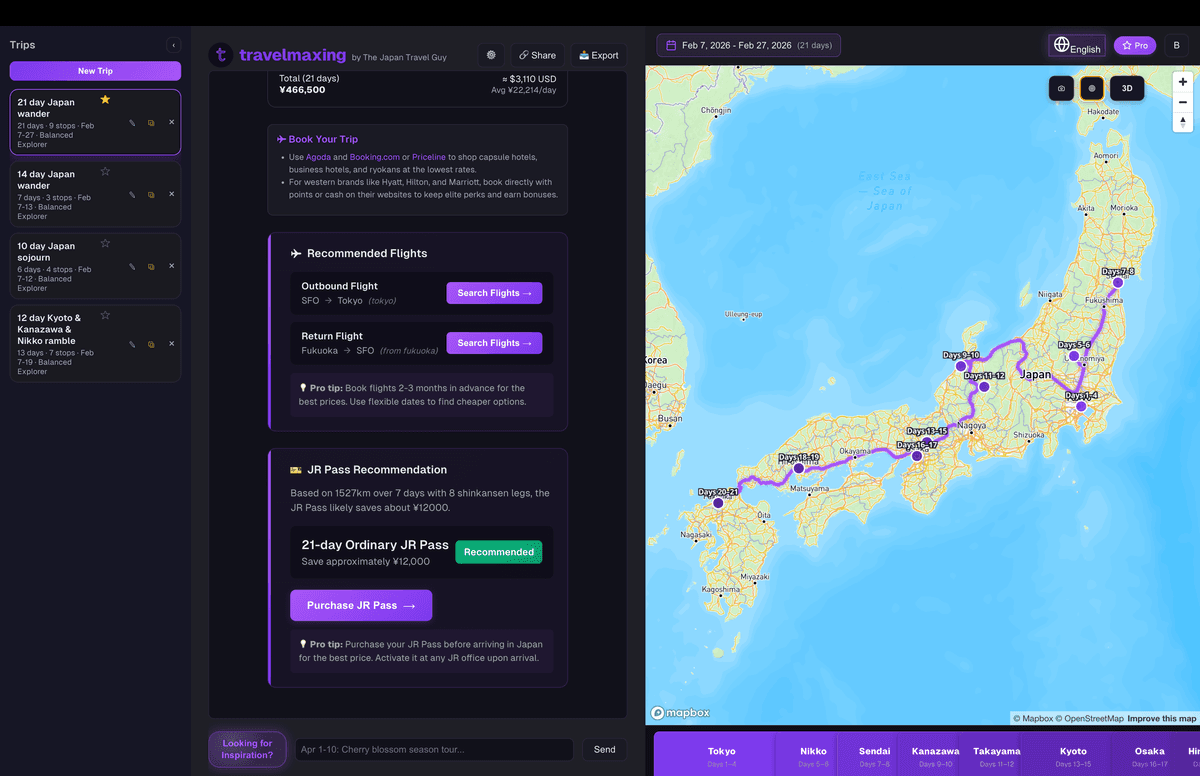
Stop Switching Between 47 Browser Tabs
I built Travelmaxing because planning my own Japan trips was chaos—maps here, transit times there, restaurant lists somewhere else. Now everything's in one place.
- This exact 7-day itinerary, customizable
- Walking routes between every location
- Restaurant recommendations with maps
How Much Does 7 Days in Japan Cost?
Real numbers from real trips. Your mileage may vary, but this gives you a solid baseline.
Accommodation (6 nights)
Budget
¥6,000-9,000/night (~¥42,000-63,000 total)
Hostels, capsules, budget business hotels
Mid-Range
¥15,000-25,000/night (~¥105,000-175,000 total)
Nice hotels, one night ryokan
Luxury
¥40,000+/night (~¥280,000+ total)
Top ryokan, 5-star hotels
Transportation
Tokyo → Kyoto Shinkansen
¥13,320 one-way Tokyo→Kyoto
Local Transport (7 days)
~¥1,500-2,500/day for metros and buses
Total transport: ~¥30,000-40,000 total transport
Food & Drink
Budget
¥3,000-5,000/day
Konbini, cheap eats, occasional restaurant
Comfortable
¥6,000-10,000/day
Mix of everything, some nice dinners
Foodie Mode
¥15,000+/day
Kaiseki, omakase, special experiences
Note: Japan has incredible cheap food. You can eat well on ¥5,000/day easily.
Total 7-Day Budget (excluding flights)
Budget
¥150,000-200,000 ($1,000-1,350)
Comfortable
¥250,000-350,000 ($1,700-2,350)
Luxury
¥500,000+ ($3,350+)
Best Neighborhoods to Stay
Where you sleep affects how you experience each city. Here's where I recommend.
Tokyo
Shinjuku
Best for: Nightlife, transport hub, first-timers. Walking distance to Golden Gai, major train lines everywhere.
My top pick for first-timers
Shibuya
Best for: Shopping, younger vibe, Harajuku access. Slightly more expensive but very walkable.
Great for those who want to be in the action
Asakusa
Best for: Traditional atmosphere, budget options, Senso-ji access. Less convenient for west Tokyo.
Perfect if you're an early riser
Kyoto
Gion/Higashiyama
Best for: Traditional experience, walking distance to temples, geisha district. Pricier but worth it.
My top pick for Kyoto
Kyoto Station Area
Best for: Transport convenience, business hotels, easy Shinkansen access. Less charming but practical.
Good for short stays or budget travelers
Downtown (Kawaramachi)
Best for: Shopping, restaurants, central location. Good balance of access and atmosphere.
Solid middle-ground choice
When Should You Visit Japan?
Each season offers something different. Here's what to expect.
Spring (March-May)
Very High CrowdsCherry blossoms typically peak late March to early April. Absolutely magical, but extremely crowded and expensive. Book 3-6 months ahead.
Tips: Check cherry blossom forecasts. Kyoto and Tokyo bloom at slightly different times. Pack layers—it can be warm or cold.
Summer (June-August)
Moderate CrowdsHot and humid (30°C+ and sticky). June is rainy season. But: festivals, fireworks, and fewer tourists at temples.
Tips: Bring a small towel, stay hydrated, embrace the slower pace. AC is everywhere. Summer festivals are incredible.
Autumn (September-November)
High CrowdsFall colors peak in November. Temperatures are perfect. Second busiest season after cherry blossom. Book early.
Tips: Late October to mid-November is ideal. Kyoto's colors are spectacular. Slightly less intense than sakura crowds.
Winter (December-February)
Low CrowdsCold but manageable. Fewer tourists, lower prices. Some temples have special illuminations. Hot springs are extra appealing.
Tips: Pack warm layers. Consider adding Hakone or other onsen. New Year's (Dec 31-Jan 3) is busy and many things close.
What I'd Skip (Honest Advice)
Not everything popular is worth your limited time. Here's what I'd drop.
Skip: Robot Restaurant
It closed in 2020 and even when it existed, it was more for 'I did a weird thing' Instagram posts than genuine enjoyment. Overpriced, overhyped.
Do instead: Golden Gai—weirder, cheaper, and you might make a friend.
Skip: Harajuku on Weekends
The crowds on Saturday/Sunday make Takeshita Street nearly impassable. You'll spend more time in human traffic than actually seeing anything.
Do instead: Go on a weekday morning. It's still busy but actually enjoyable.
Skip: Tokyo Tower
Skytree has better views and is more impressive. Tokyo Tower is nostalgia for Japanese people who grew up with it, but for tourists, it's the lesser option.
Do instead: Tokyo Skytree or the free observation decks at Tokyo Metropolitan Government Building.
Skip: Most 'Themed' Cafes
Maid cafes, owl cafes, hedgehog cafes—most are tourist traps with mediocre coffee, stressed animals, and uncomfortable vibes.
Do instead: Exception: Cat cafes can be nice if you research humane ones. Otherwise, find a real kissaten.
Skip: Kiyomizu-dera at Peak Hours
The temple itself is beautiful but the midday crowds can be brutal. You'll spend more time in line than appreciating anything.
Do instead: Go early morning or late afternoon. Or prioritize other temples.
Frequently Asked Questions
How much does 7 days in Japan cost?
Budget travelers can do 7 days for around ¥150,000-200,000 ($1,000-1,350) including accommodation, transport, food, and activities—but excluding international flights. Mid-range travelers spending comfortably should budget ¥250,000-350,000 ($1,700-2,350). This assumes staying in business hotels or nice hostels, eating a mix of convenience store meals and sit-down restaurants, and visiting a reasonable number of paid attractions.
Is the JR Pass worth it for 7 days?
For a Tokyo-Kyoto-only itinerary, usually not. The 7-day JR Pass costs ¥50,000, while a round-trip Shinkansen ticket is about ¥27,000. You'd need to add significant JR travel within cities or day trips to make it worthwhile. If you're adding Hiroshima, Osaka day trips, or Nara via JR, then it starts making sense. Use a JR Pass calculator with your specific plans.
What's the best time of year to visit Japan?
Cherry blossom season (late March-early April) and autumn colors (mid-November) are the most beautiful but also most crowded and expensive. Spring (May) and autumn (October) offer great weather with smaller crowds. Winter is coldest but cheapest with the fewest tourists. Summer is hot and humid but has amazing festivals.
Should I stay in Tokyo or Kyoto longer?
For first-timers, I recommend 3-4 nights Tokyo and 3 nights Kyoto. Tokyo has more to do overall, but Kyoto's temples and traditional atmosphere make it essential. If you love food, nightlife, and urban exploration, lean Tokyo. If you prefer temples, nature, and traditional Japan, lean Kyoto.
Can I do Japan without speaking Japanese?
Absolutely. Major tourist areas have English signage, menus often have pictures or English, and Google Translate's camera feature is a lifesaver. Most Japanese people will go out of their way to help you even with zero shared language. Learn a few basics—'sumimasen' (excuse me), 'arigatou gozaimasu' (thank you)—and you'll be fine.
How far in advance should I book?
For peak seasons (cherry blossom, autumn leaves, Golden Week, New Year), book flights and accommodation 3-6 months ahead. For off-peak, 1-2 months is usually fine. Popular restaurants with English reservation systems should be booked as far ahead as possible. Train tickets can be bought on arrival.
Is 7 days enough for Japan?
Seven days is enough for a great introduction to Japan, covering Tokyo and Kyoto's highlights. You'll leave wanting more—which is kind of the point. Many people return for 2-week trips to explore Osaka, Hiroshima, the Alps, or southern islands. But if 7 days is what you have, it's absolutely worth the trip.
Continue Planning Your Trip
14-Day Itinerary
Have more time? Add Osaka, Hiroshima, and deeper exploration.
JR Pass Calculator
See if the JR Pass is worth it for your specific itinerary.
Best eSIM for Japan
Skip pocket WiFi. Here's what actually works.
Tokyo Neighborhoods
Deep dive into where to stay in Tokyo.
Kyoto Food Guide
Where to eat in Kyoto—from street food to kaiseki.
Budget Calculator
Get a personalized estimate for your trip.
Ready to Book Your Japan Trip?
Get this entire itinerary with maps, transit directions, and customization options in Travelmaxing. It's free to try.